People who truly need a dermatologist often search for a skin doctor near me without hesitation. These searches are usually not about improving appearance. They are about solving a problem. Most people feel uncomfortable, confused, or scared because their skin suddenly doesn’t feel normal anymore.
Skin problems are not just physical. For many people, they slowly turn into emotional stress. Ongoing skin issues can affect self-esteem, make people feel unhappy, and even change how they interact with others. When skin problems last for a long time, they can become mentally exhausting.
When skin problems are clearly visible, people may start avoiding mirrors, social gatherings, or photographs. Some feel embarrassed and keep the problem to themselves. Others try many treatments, creams, and home remedies, but feel frustrated when nothing works. Not knowing whether the condition will improve or get worse only adds to the stress.
At this point, people are no longer interested in home remedies or product recommendations. What they really want is medical clarity. A dermatologist provides clear answers through proper examination and medical knowledge. They explain what is happening, what treatment is safe, and what should not be ignored.
This blog is meant to help you understand when you should see a dermatologist, what a skin doctor actually does, and why early medical guidance can protect your skin and prevent bigger problems in the future.
Why People Delay Visiting a Skin Doctor
Most skin problems do not start suddenly. They develop slowly, which is why people delay seeking help.
Common reasons include:
- Assuming the issue is temporary
- Trying online remedies first
- Using cosmetic products suggested by friends
- Fear of strong treatments
- Confusion due to too much information
Many people wait until the skin problem becomes visible, painful, or emotionally stressful. By then, treatment often takes longer.
Searching “skin doctor near me” is usually the point where guessing stops and concern becomes real.
Skin Is Not Just About Appearance
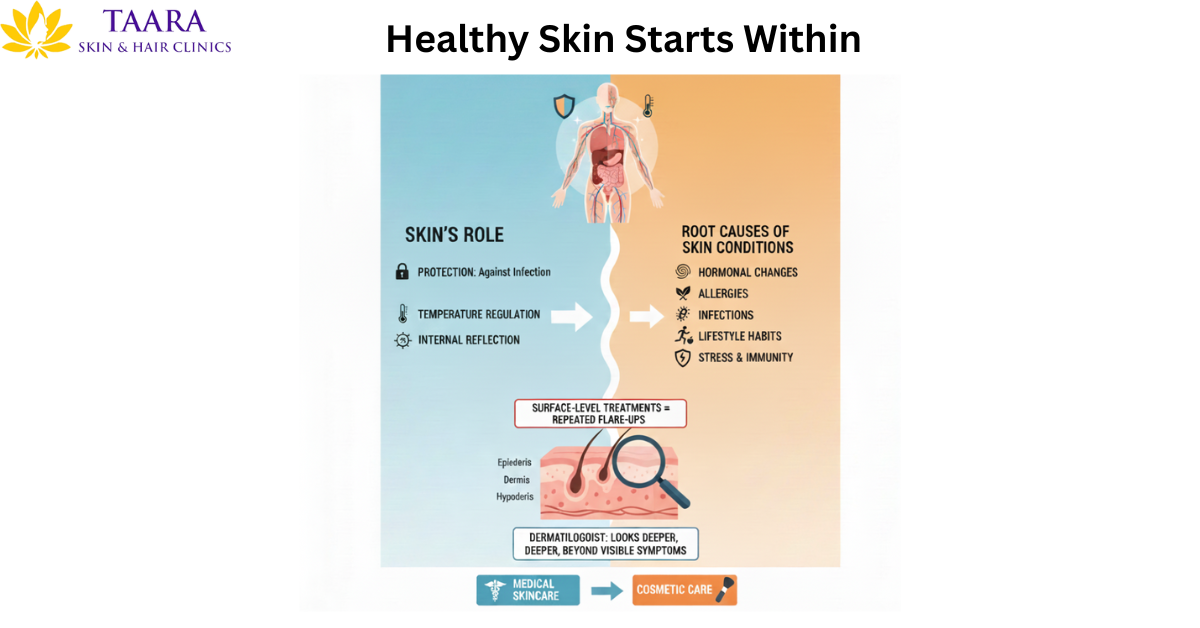 Skin is the body’s largest organ.
It protects you from infection, regulates temperature, and reflects what is happening inside your body.
Many skin conditions are linked to:
- Hormonal changes
- Allergies
- Infections
- Daily Life habits
- Stress and immunity power
Treating skin problems only on the surface often leads to repeated problems. A dermatologist looks deeper, beyond what is visible.
This is why medical skin care is different from cosmetic care.
Signs You Should Not Ignore
Consider a dermatologist consultation if you find any of the following:
1. Skin Problems That Keep Coming Back
Acne, rashes, and itching which temporarily get better and then return again, usually require a medical evaluation.
2. Sudden Changes in Skin Color or Texture
You should always have your skin checked if it becomes dark, red, rough, or you get an unusual type of stain.
3. Acne That Leaves Marks or Scars
Non-clear acne is not only a problem for teenagers. Medical treatment is necessary to prevent scarring if you have adult acne.
4. Severe Itching, Scaling, or Redness
These may be symptoms of allergies, infections, or even chronic skin diseases.
5. Sensitivity to Multiple Products
If your skin reacts to most products, then the skin barrier might be already damaged
These signs usually lead people to look for a nearby skin doctor instead of trying another product.
Why Home Remedies and OTC Products Often Ineffective
People resort to home remedies because they seem to be safe and within one’s reach. Over-the-counter creams can be bought without much hassle. However, most dermatological problems have aetiologies beyond the skin.
Reasons why these methods fail most of the time:
- They do not deal with the source of the problem
- They may very briefly alleviate symptoms
- Wrong usage can aggravate sensitivity
- Referring to a doctor late enables the disease to deepen
In certain instances, the continuation of self-medication may result in the exacerbation of the dermatological condition to such an extent that it becomes difficult to treat later on.
A dermatologist facilitates the process of knowing what the skin really needs rather than following online trends.
What a Dermatologist Looks for During Consultation

Many people expect immediate treatment during a dermatology visit. In reality, the first step is understanding.
A skin doctor evaluates:
- Skin type and sensitivity
- Pattern and duration of the problem
- Medical history
- Lifestyle and daily routine
- Past treatments and reactions
This evaluation aids in determining if the problem is one that results from inflammation, hormones, infection, allergy, or environment. Any therapy without this step is simply a game of guesses.
Common Conditions That Need a Skin Doctor’s Attention
A dermatologist treats more than acne or pigmentation. Medical skin care covers a wide range of issues.
Some common reasons people consult a skin doctor include:
- Pimple and pimple marks
- Dark spots and melasma
- Skin allergies
- Rashes and infections
- Dandruff and scalp conditions
- Hair loss related to skin health
- Early aging signs
- Chronic itching
Each condition requires a different medical approach. What works for one person or individual may not work for another.
Why Early Consultation Matters
Skin conditions respond better when treated early. Delaying care can lead to:
- Longer treatment duration
- Increased risk of scarring
- Spread of infection
- Chronic skin sensitivity
Early dermatology consultation often reduces the need for aggressive treatments later.
This is why people searching “skin doctor near me” are often already at a stage where professional guidance is needed.
Medical Treatment Does Not Mean Harsh Treatment
One common fear is that visiting a dermatologist means strong medicines or procedures. This is not always true.
Good dermatologists:
- Start with the least aggressive option
- Explain why a treatment is needed
- Monitor response closely
- Adjust plans based on skin reaction
Medical guidance is about precision, not intensity.
How to Select a Suitable Skin Doctor Near You
In case you decide to work with a skin specialist please concentrate more on the doctor’s approach than on the popularity of the dermatologist.
A good skin doctor:
- Explains the condition clearly
- Answers questions patiently
- Sets realistic expectations
- Avoids unnecessary treatments
- Focuses on long-term skin health benefits
Those physicians who offer to give you instant results or permanent cures are almost certainly wrong, and you should be careful if you come in contact with such a doctor.
What Patients Often Say After the Right Consultation
Patients who consult a dermatologist at the right time often say:
- “I finally understood what was wrong with my skin.”
- “I stopped wasting money on random products.”
- “My skin became calmer, not just clearer.”
Clarity reduces anxiety. Understanding builds trust.
Skin Care Is a Long-Term Process
Healthy skin is not achieved in a single visit. It involves:
- Correct diagnosis
- Consistent treatment
- Behavioural changes
- Proper follow-up
Dermatologists guide patients through this process step by step.
This long-term view is what separates medical skin care from cosmetic quick fixes.
When Searching ‘Skin Doctor Near Me Is the Right Decision
You should not wait until skin problems affect your confidence or comfort.
If you are unsure about:
- Why a skin issue started
- Why it is not improving
- Whether it will leave marks
- Which treatment is safe
Then it is already the right time to consult a dermatologist.
Final Thought: Skin Care Is Medical Care
Skin problems are very often considered only as an issue of the person’s appearance. What people usually forget is that these problems affect the individual’s comfort, self-confidence, and even health. The development of acne, pigmentation, itching, or hypersensitivity that happens constantly can slowly take over a person’s daily life. Probably, this may happen in such a way that the person’s social and professional interaction comfort and confidence levels drop greatly.
Usually, people are guilty of the mistake of disregarding their initial signs and for that reason, they have to live with these problems for a longer period, which consequently becomes more difficult to handle. Oftentimes, the skin ailments are accompanied by very subtle symptoms, which can hardly be noticed. It might be that the tiny area of skin, isolated breakouts, or a slight irritation first appearing may seem to be too minor to take into consideration.
However, if these indications are continuously neglected and the people that have them keep thinking that the issue is not serious, they gradually escalate.
At the point when all these happenings become recurrent, the skin that has been ignored for a long time might become scarred, extremely sensitive, uneven in color, or it can be a situation of skin diseases that will have to be treated for long periods and will require complicated therapies because of their frequent relapses.
A dermatologist has to identify the problem to the patient not only by face-to-face contact, but also via stepwise communication – he/she will clarify the disorder in layman terms, be the first one to foresee outcome, and finally, select the most suitable medicine for your skin.
In this manner, the skin will be shielded against the risk of temporary and fast recourse which can bring relief for just a very short period of time. Medically addressing skin problems leads to more definite and sustainable outcomes. Take the Right Step for Your Skin Today.